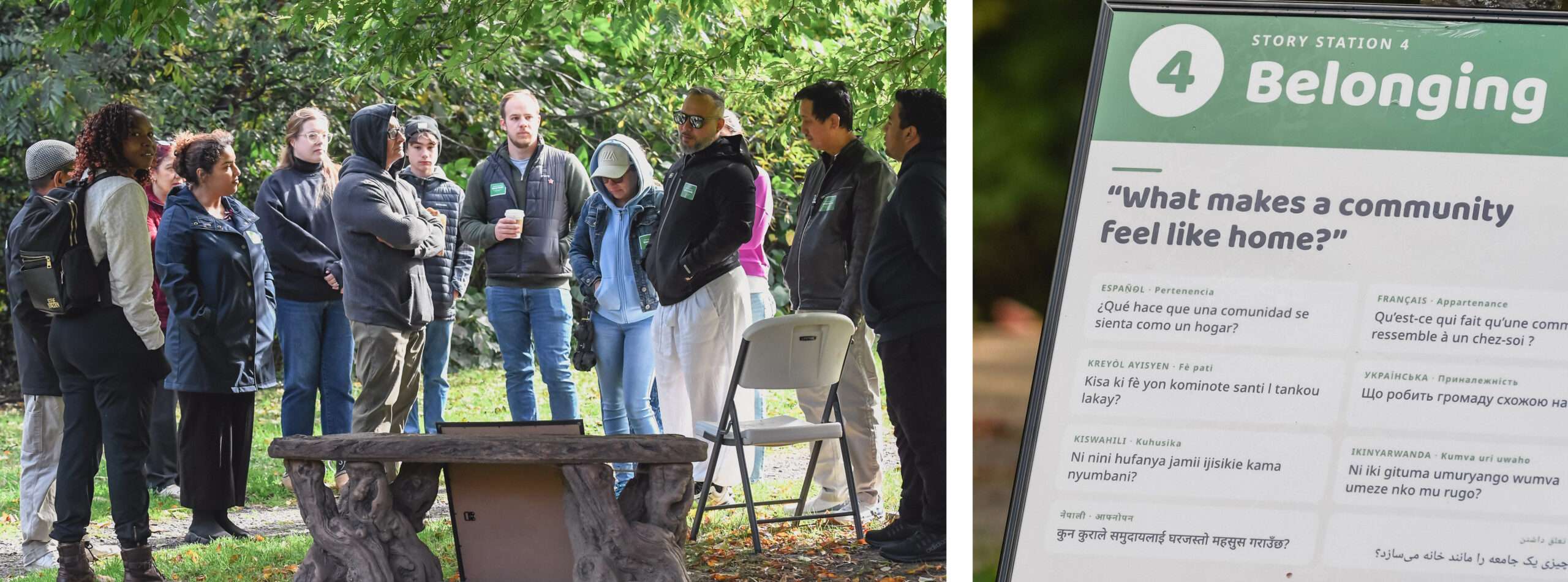
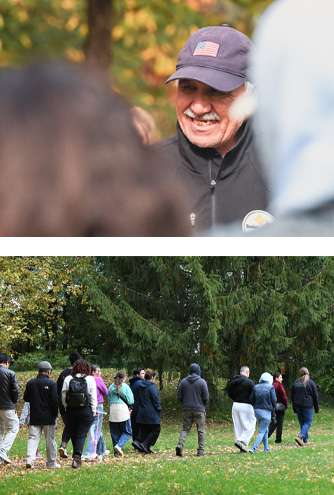
Brisk mid-October weather and a bit of mud along Nay Aug Park’s Sarabi Trail did not keep participants from gathering for the Community Story Walk. A shared effort between Catholic Social Services of the Diocese of Scranton (CSS) and United Neighborhood Centers of Northeastern Pennsylvania (UNC), the event brought neighbors from diverse cultures and backgrounds together for a morning of fresh air and conversation. The trees, trails, bird sounds, and green space—also known to support mental health and well-being—gently echoed the event’s theme of connection and community.
As members of Moses Taylor Foundation’s Mental Health Learning Community Cohort, CSS and UNC frequently work together to deliver culturally responsive mental health interventions. CSS’s Bridges to Wellness program and UNC’s Multicultural Wellness Program both aim to remove barriers to service and foster well-being in the local immigrant and refugee communities. Unified events like the Story Walk are part of the organizations’ broader, symbiotic partnership.
Participants at the morning’s Story Walk—including immigrants, refugees, interpreters, medical students, volunteers, and community members—moved along the trail together. The route included five stations, each marked with a specific theme—A Place, A Journey, A Neighbor, Belonging, and Hope. At every stop, the group was asked one question, printed in 10 languages. Some participants shared stories in great detail. And some simply listened, occasionally nodding or smiling to show understanding or acknowledge a shared experience.
As the event went on, the sun warmed the day. Everyone became more comfortable with each other, and conversation flowed more easily, too. Participants allowed themselves to be vulnerable, open, and honest. A few talked about how feeling so lonely, lost, scared, and invisible in this country nearly drove them right back to the regions they had left. Organic, natural connections made at events like this can truly become a lifeline for immigrants and refugees starting a completely new life in the United States.
Joe Mahoney, Chief Executive Officer of CSS, mentioned the importance of lateral connections. Events like Story Walk can become a no-pressure opportunity for someone to build their own personal network and become part of a larger community. Lateral connections—interconnected relationships between individuals navigating similar situations and challenges—are especially critical in the immigrant and refugee community. Rather than looking to an agency or a mentor, people with strong lateral connections can turn to each other for specific guidance, advice, resources, and support.
Information—and fear—flows quickly and freely through lateral connections. Following recent immigration enforcement activity in our region, some who had planned to attend the Story Walk felt it was safer to stay home. Their absence was a quiet reminder of how many of our neighbors are living with uncertainty every day.
Ruth Cuinica, Bridges to Wellness Program Supervisor, acknowledged the impact of fear and immigrants' and refugees' tendency to stay invisible. “When people are afraid, they tend to keep to themselves. They stay isolated and avoid opportunities to connect. Being alone is not what people need. We want them to know that they are not—and should not be—alone.”
At each Story Walk station, one topic led to the next, and a few participants noted how simple but meaningful cultural differences between the U.S. and their home countries have shaped their experience as immigrants or refugees. One woman chuckled and talked about how people in the U.S. “don’t actually want to know how you are.” She shared, “People might ask, ‘How are you?’ but they don’t really want a full answer. When I first came here, I didn’t know it was just a nice greeting, not a question. When people asked how I was, I used to tell them in detail until I realized they were just looking at me, confused about why I was talking so much. I was very lonely and looking for a connection anywhere. In my culture, people do not move so fast. They talk to each other more. At first, it was difficult to find friends or anyone to talk to. I had to keep telling myself, ‘Keep moving. Just keep moving forward.’”
Some participants opened up about the war, violence, and unrest that forced them to flee their home countries. One man shared how he refused an order to fire on peaceful protesters, a choice that cost him his freedom. After serving time in prison, he found that his release did not bring safety. Targeted by those who still wanted him punished for standing up for others, he fled, beginning a years-long journey across jungles, cities, and borders. Today, he is seeking asylum in the U.S. He shared his story through a friend he met in UNC’s Language Partnership class, where the two are learning to communicate with each other a little more each week.
Despite the serious undertones in many stories, there was also laughter, camaraderie, and hope. The Story Walk wrapped up with a variety of breakfast foods and time for participants, volunteers, and interpreters to eat, mix, and mingle.
As the event came to a close, Prisca Chika Poly, Congolese Community Peer at CSS, spoke straight from the heart, sharing her story with the entire group, including her co-workers who had never heard it all before. Prisca described, in vivid detail, the circumstances that led her to leave her home country and a bit about her personal journey as an immigrant—and now as a wife and working mother—in the U.S.
Highlighting memorable interactions and people who have influenced her life, she stressed the importance of simply being kind and helping others feel truly welcome.
Prisca’s deep love for humanity, empathetic nature, and commitment to service have been shaped by her lived experience. “Everyone has traditions, their own background, their unique story. You can't know someone without getting to know them. I know that small acts of kindness can mean the world to someone, just as so many small interactions have meant the world to me.” She continued, “I tell people I meet, ‘If you are struggling, if you are lonely, you can call me anytime.’ I will never get tired of helping. I will never stop helping.”
The Bridges to Wellness team is hopeful that the Greater Scranton community will continue to become more diverse and accepting. The next Community Story Walk is planned for May 2027.
Bridges to Wellness, a Culturally Responsive Mental Health Program or Catholic Social Services, Diocese of Scranton
Through this initiative, peers representative of the population served are recruited as Wellness Coaches. They are trained to offer culturally sensitive workshops on mental health concepts, coping strategies, and available resources—and facilitate community-building opportunities (like candle-making or learning to cook specific ethnic foods together) to bring people of all races, cultures, and languages together. Wellness Coaches also lead peer support groups to promote mental health awareness in familiar, comfortable spaces where participants already feel safe and welcome.
United Neighborhood Centers of Northeastern Pennsylvania’s Multicultural Wellness Program
Through its Multicultural Wellness Program, UNC employs a licensed social worker to engage with diverse communities and offer a range of mental health services, including counseling, peer support, and crisis intervention. The social worker also partners with local clinics to ensure coordinated care and with other community partners to help individuals connect with resources in their local community. The Multicultural Wellness Program addresses specific needs of diverse populations, reduces stigma through education, provides services in clients' preferred languages, and incorporates cultural understanding into care delivery. This program aims to foster trust and promote long-term engagement in mental health services.
The CSS and UNC teams continue to collaborate on events and programming—fostering not only personal connections within the community but organizational connections to work toward parallel missions.
Click here to learn more about the organizations participating in the Foundation's Mental Health Learning Community Cohort and their impactful projects.